Companions
What changed in v0.2.0 short form
Everything this build brought, one line each — so this page says what it is before it says how the game works. The long form, with every reason and number behind them, is CHANGELOG.md in the repository.
v0.2.0 this build 2026-07-21
Boiling, reachable
- Right-click context ring
- Two new orders — Scoop water fills the skin and then the pack at a shore; Boil water loads pack and…
- The waterskin pours — Right-click the tool slot in the character sheet and its contents come into your hand as water…
- One waterskin per in-game hour
- Console: boil [<units>], context [fire|water]
Changes
- Sicknesses that name their cause (ROADMAP 7.8)
Fixes
- A fire raised from twigs can be fed with twigs (it could only be built with them), and…
- Wildlife no longer walks through built walls and closed doors
Overview
What the game is, and the shape of a run.
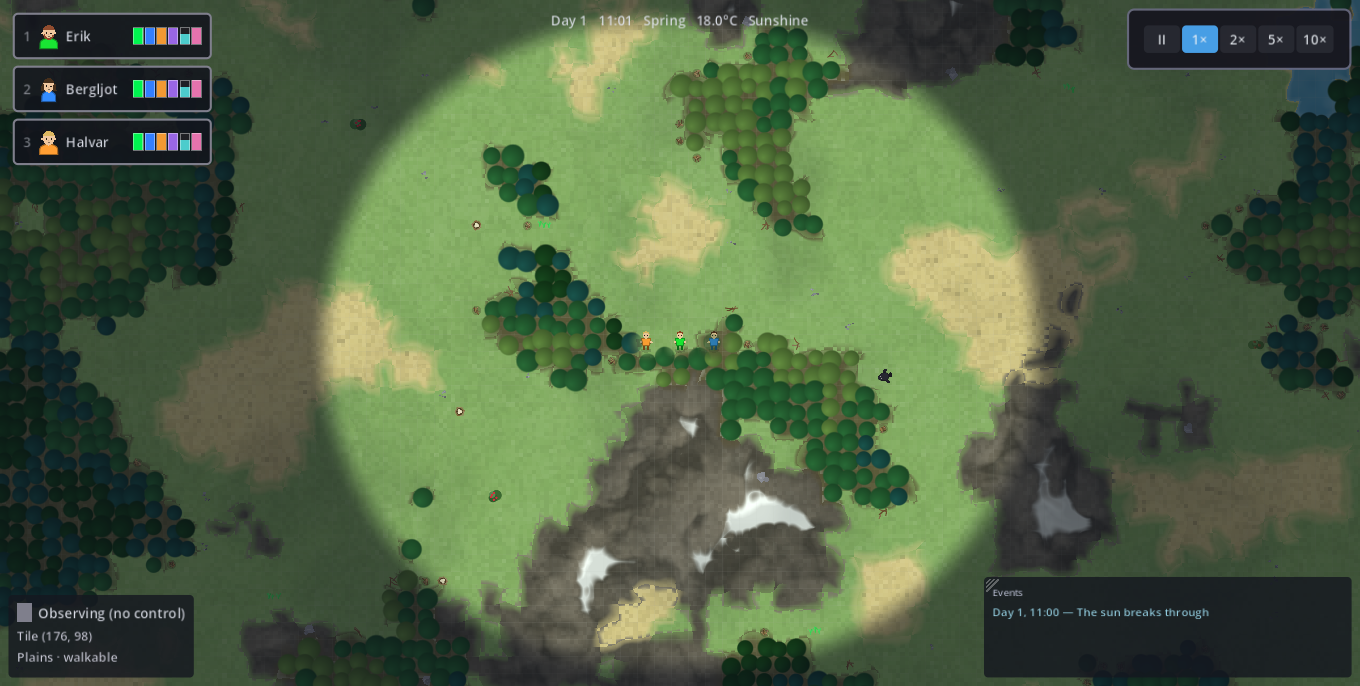
You control a party of three companions (recruiting more, up to ten, is planned) from an RTS-style top-down view: box-select, right-click to command. There is no player avatar — the three are equals. Every one has the full set of survival stats and can die individually; losing one is meant to feel tragic. The hardest difficulty is permadeath. The only threats are nature — food, water, temperature, weather, seasons and distance — plus reactive wildlife that may defend itself. Nothing ever attacks your base.
A run is a cycle of three phases
- The manual opening — everything by hand, no automation. Scout for a viable site, live hand-to-mouth off what you find.
- The automated base — buildings unlock jobs, each companion's rule program runs the day, the settlement hums.
- Exhaustion → migration — the land wears out, the party packs what it can carry, treks, and starts over stronger: skills, equipment and recruits persist, the place does not. Each year winters bite harder.
The 512×512 map is budgeted for roughly 3–5 settlement cycles — that is the designed run length. Phases 1 and 2 exist today; phase 3 (a forced push and a tools/equipment system) is the big open milestone.
Move & look WASD · F · Tab
- WASD pans the camera (free look). The view stays where you put it — selecting or commanding never yanks the camera.
- F centres the camera on the selected character and follows it (a group is framed at its centre). Tab does the same while switching companions.
- Right-click commands every selected character (see Command); a green ping marks the ordered spot. Hold right-click to steer continuously — the selection follows the cursor until you release.
- Dense forest and loose sand slow walking to 80%.
- Mouse wheel or +/- zoom; M snaps to the widest zoom. Mouse at a window edge scrolls the view (tune speed/width in Esc → Settings → Gameplay).
- There is no minimap and no overview map — you never see the whole island at once. Reading and remembering the land is part of the game.
- The time-warp bar sits top right (pause, 1–10×). Switch on Esc → Settings → Graphics → Show FPS and the frame rate appears directly under it — green above 50, amber above 30, red below. It updates four times a second on real time, so time warp and pause do not change how it reads.
Your party 3 → 10 companions
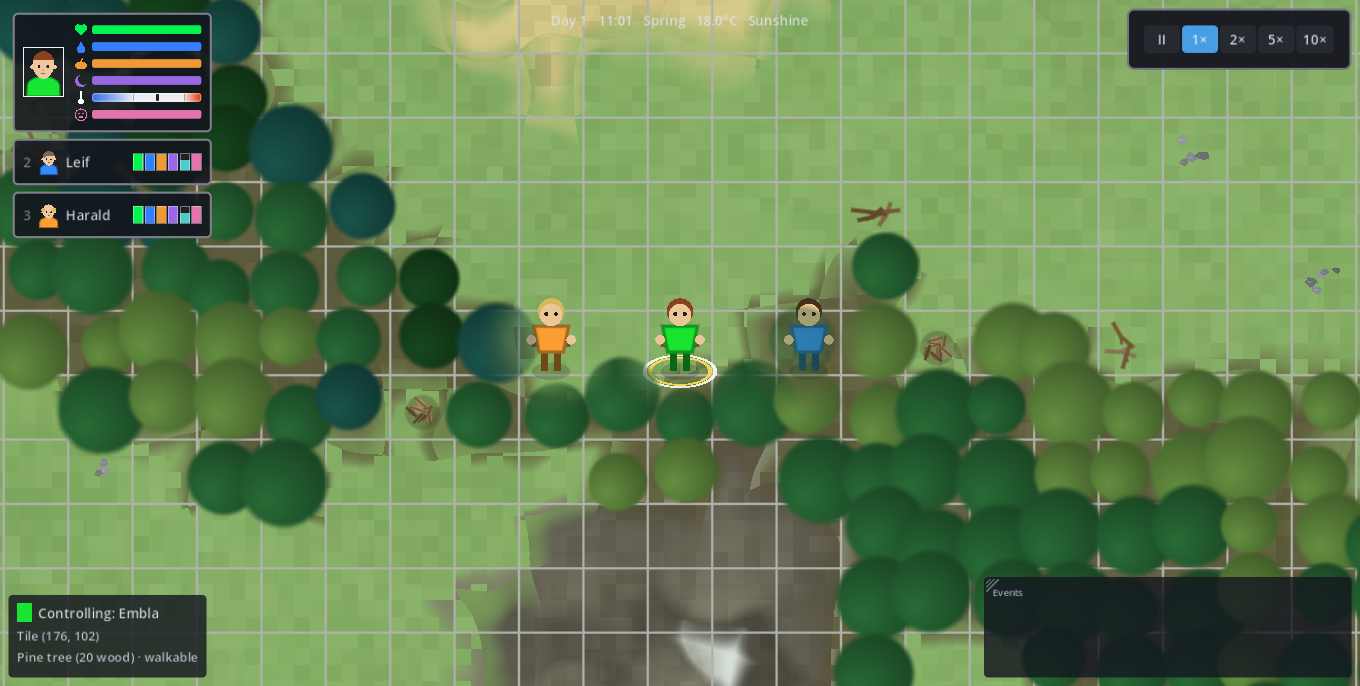
- Left-click a character to select it (green / blue / orange; a white ring marks it). Exactly one selected = it is "yours": E-gather and build use it, and it walks your right-clicks at full speed.
- Drag a box to select several and command them together.
- Left-click empty ground deselects — observer mode; everyone just runs its jobs.
- The bottom-left info panel follows the mouse: hover any tile for terrain + what stands on it (tree species & wood left, water salinity, buildings, stockpile usage, plant stock); hover a character for its current activity. Fog applies.
- Tab switches control to the next companion; 1–9, 0 select directly (tap twice to also centre the camera). Hotkeys are fixed for the run — a dead companion's number stays vacant.
- Companions learn by doing. Walking trains Running (speed), each trade trains its own skill, heavy trades & building train Strength (carry + build speed), and enduring cold/rain/exhaustion hardens Resilience (falls ill later). A run's veterans are made, and they are what you carry to the next settlement.
- Strangers come knocking. Every so often a wanderer walks in out of the wild and waits a few days at the settlement. Left-click them for their panel: name, body, base attributes — and nothing else, because a recruit arrives unskilled. Take them in or send them on; wait too long and they leave. The party is hard-capped at ten, and a new pair of hands eats before it earns.
- Not everyone means it. Some wanderers are false companions: they work slowly, help themselves to the stores, and one night they are gone with whatever they could lift. Nothing on the panel gives it away — the event log does, over days (someone at the stores after dark; a day's work that came up short). Sharp companions (Perception) name names. Expel anyone who joined from their character sheet (C) — and be wrong at your own cost.
Command — right-click RMB
Right-click sends every selected character; what happens depends on what you click. Your word is absolute — a character never breaks off an order, even to save itself. It posts a red warning when critical and carries on; abort the order yourself if you want it to live.
| You click… | They… |
|---|---|
| Open ground | Walk there (paths around deep water, mountains, house walls) |
| Fresh water / a well | A ring of choices: Drink (until thirst is full, then top up the waterskin) or Scoop water (fill the skin, then load units into the pack) |
| Tree / rock / plant | Harvest into the carry (trees until felled) |
| A bed (its exact cell) | Sleep until fully rested |
| A campfire | A ring of choices: Tend fire (refuel from the carry or nearby stores — wood or twigs) or Boil water |
| A dropped stack | Pick it up into the carry |
| A stockpile 1 selected | Walk there and open the transfer window |
| A stockpile group | Haul carries there and unload onto the tiles |
| Another companion 1 selected | Walk over and open the carry-to-carry transfer window |
| A blue construction site | Join the build: fetch, deliver, raise it |
Shift+right-click queues the order as a waypoint. A plain right-click replaces the whole queue. Nobody looks after themselves at all — drinking, eating, warming and sleeping happen only on your order or through the rule program (T).
Gather — hold E E
Hold E next to a target; a ring fills over its harvest time. Gathered items go into that character's carry, limited by weight (~40 kg, raised by Strength).
- Trees → wood: each forest tile is one tree; the whole wood stock drops when it falls (the tile turns to grass). Strikes are banked — stop and finish later. Four species by shade: birch (10 wood), pine (20), spruce (25), oak (35).
- Rocks → stone and fishing take ~10× ordinary work — plan whole days; a mason's yard / fisher's hut put workers on them around the clock.
- Herbs, berries, roots regrow in place (not in winter). Bird nests (spring only, gone for good when robbed), mushrooms (summer+autumn, forest edge), hazel nuts (all year, never rot, but a cleared bush is finished and the next grows out of sight), mussel beds (salt coast, year-round, spoil fast).
- Free ground pickups (a half-second stoop, gone once taken): twigs & leaf piles at the forest edge, loose stones on the plains.
- Wild hemp → plant fibre — grows only on damp ground beside fresh water (river banks and lake shores; never the salt coast, never inland). Tall fanned stalks, regrows in ~5 days outside winter. Fibre is not string: spin it into cordage on the Crafting tab, and cordage is what a bowstring and a fishing line are made of. No hemp in reach → no bow and no rod, so it is one more thing that makes a settling site good or bad.
- Hunting takes a bow (craft one once a Hunting lodge stands). Deer & pigs flee faster than you walk — you shoot them: embody a hunter, hold H, a swaying reticle rises, lead the moving animal, release to loose. A hit is aim, not luck. A shot spooks the prey — one clean opening shot, then it bolts. The Hunter rule shoots the same way on its own, and with nothing in sight it takes a stand instead of falling through to the next rule: it walks to the nearest known forest cell (failing that, anywhere outdoors — never under a roof) and waits there, reading "No huntable animals in sight - waiting". Hunting is mostly waiting.
- Fishing takes a rod (a pole plus a line of cordage; craft one once a Fisher's hut stands). The hut grants the fishing right to its water, the rod is the tackle: no rod in the pack → the companion will not fish, the Fisher rule stays blocked, and the hut's task postings are left for whoever is equipped. Rods are per companion — three fishers need three rods.
Eight creatures roam: deer & pigs are the herds you live off; pigeons & crows fly where you cannot follow; beavers keep to fresh water; badgers are slow enough to corner; wolves and bears hold their ground (a bear is the biggest meat on the map). Nothing out there hunts you — yet.
Stay alive
Health, Thirst, Hunger, Tiredness and Temperature drain over time; Mood is a secondary, non-lethal stat. Every companion is a compact row top-left; the controlled one unfolds to full bars. Buff/debuff badges beside the card say what is on a companion — green = boon, red/magenta/violet = malus. When any Health falls into the red, the whole screen sounds the alarm (red rim, heartbeat) so an off-screen death can't be missed.
| Danger | What it does | The fix |
|---|---|---|
| Thirst empty | Kills in ~half a day (fastest) | Drink at fresh water / well; keep a waterskin full |
| Hunger empty | Starves over several days | Eat from carry (Eat rule / sheet double-click); cook & smoke a surplus |
| Tiredness low | Walk −25%, work −40%; sleep debt drains it up to 60% faster | Sleep in a bed (heals Health too); bedroll on a trek |
| Temperature | Below 4°C or above 35°C drains Health | Warm at a fire/indoors; cool at water/well |
| Wet (rain/swamp) | Feels up to 30% colder, −5% speed, sinks Mood | Dries only at a burning fire or under a roof (~4h) |
| Fever | From cold, wet and exhaustion. −25% work, drains Health if untreated; can kill | Bed rest + herbs from the carry |
| Dysentery | From untreated water. −20% work — and it makes you thirstier, the trap that feeds itself | Bed rest + herbs; then clean water only |
| Food poisoning | From raw or spoiled food. −30% work, the hardest hitter of the three, but it passes fast | Bed rest + herbs; cook or smoke meat first |
| Still water (lake/pond) | Every untreated gulp builds the dysentery load (~12 per full thirst bar) | Drink at running water or a well; or draw it and boil it in a fire's pan |
| Despondent (Mood floor) | Refuses its rule program AND stops feeding itself | Direct orders only — nurse it dry, warm, fed, healthy |
What hurts you doesn't let you heal: an empty Thirst/Hunger bar, or a freezing/ overheating body, suspends rest regeneration entirely — the sleeper rests off tiredness but wakes no healthier. Winter is the exam: farms lie dormant, plants stop regrowing, no animals are born. Stockpile in autumn; nuts, fishing and mussel beds work year-round.
Build — press Space Space
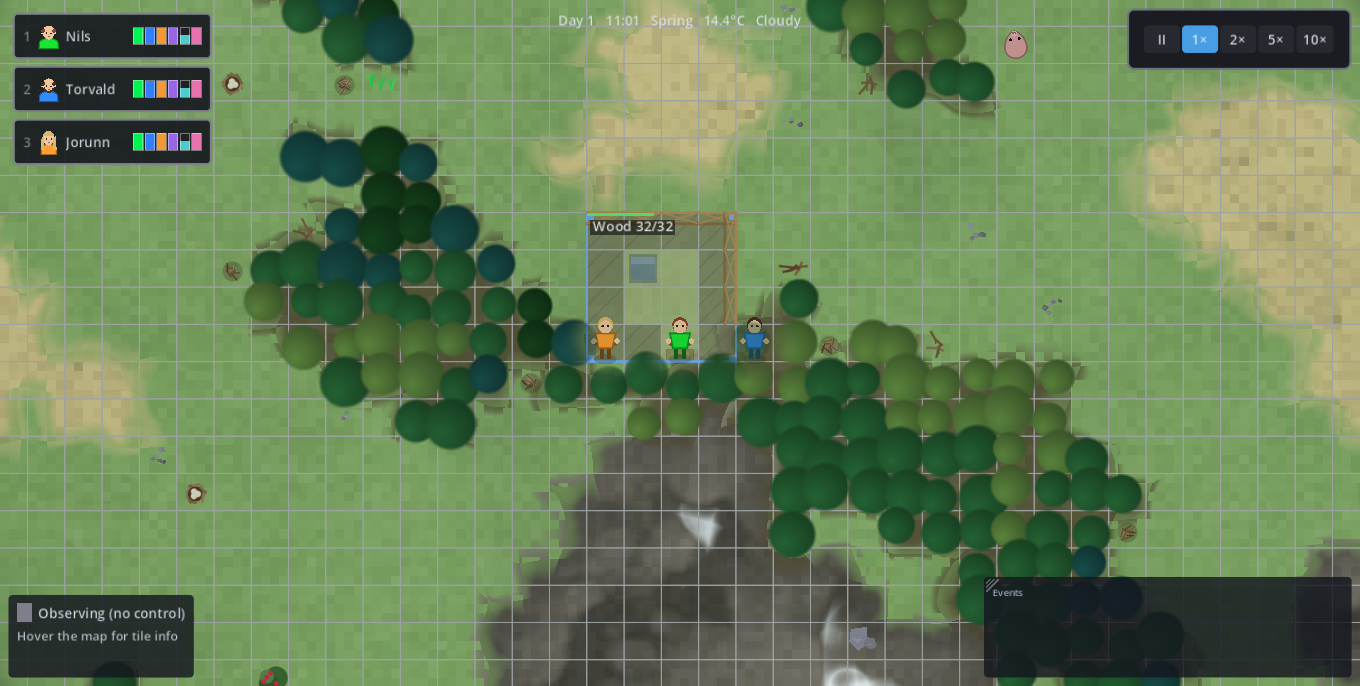
You start with nothing. Space opens the build ring (radial menu, 2026-07-20): an inner ring of categories — Workshops, Structure, Supply, Demolish — where left-clicking a category opens it in a second, outer ring. Hovering any entry spells it out in the info panel below the circle, cost per material included (green = affordable now, red = not). Place it, and every selected character goes to build it (nearest one if none selected). R rotates the ghost before placing.
The centre always goes back one ring, and closes the menu on the top level — the same thing right-click and Esc do, so there is one rule for the way out. Space closes it from any depth. Only two rings are ever drawn: opening a category replaces the outer ring rather than adding a third, so nesting is free and the circle never grows. Greyed entries come in two kinds that must not be confused — a padlock is a player goal (the workshop that unlocks it does not stand yet), a dashed outline is a planned placeholder that does not exist in the game yet.
There is no ready-made house. The drag-to-size prefab was retired from the player's hands (2026-07-20): every house is now designed out of walls, doors and floors, and is whatever shape you enclose. Job buildings stay simply placed and the farm stays drag-to-size — a workshop is equipment, not architecture; only the home is the player's design.
| Building | What it does | Note |
|---|---|---|
| Campfire | Warmth + hearth (fuel / cook) | 9 twigs or 3 wood (see below); action area 20; physical heat radius 3.5 |
| Well | Drink, refill skins, cool off | The only drink source workers use on their own — keeps flowing when water freezes |
| Bed / Stone hearth | Furniture | Not in the build ring at all — placed from the room panel |
| Straw bed | Furniture that also camps | The one piece in both lists: the room panel and the Supply ring, so it can be thrown down beside the campfire before any room exists (secondary_category) |
| Wall / Door | Enclose a warm, roofed room | Walls drawn as straight chained runs; door is walkable |
| Bridge | The only way across a river | Drag a deck bank-to-bank; turns water walkable |
| Wooden Floor | Raises Mood inside a room | Ground, not furniture — beds/fires stand on it |
| Road | Walk ~35% faster along it | Ground like a floor; stone per tile — the price, not the speed, is what keeps siting honest |
| Stockpile zone / Storage box | City stores (1 type/tile, 20 units) | Zone is free; drag out on open ground |
| Water barrel | Stores water (20 units, clean or stale) | Winter/drought reserve; DRAW + HAUL fill it; serves the clean water first |
| Smokehouse | Cures fresh food → preserved | Doubles as a stockpile |
| Lumber camp / Fisher's hut / Mason's yard / Hunting lodge | Workshops | Each unlocks its trade for the rules (fishing and hunting also need the rod / bow in the pack) |
| Farm | Vegetables (Farmer tends it) | Dormant in winter |
| Planning table | +6 rule blocks; copy programs; opens the task board | — |
Two prices for one building. A buildable may list alternative costs — the campfire's 9 twigs or 3 wood (2026-07-21). Twigs lie on the ground everywhere, so the first fire of a run never has to wait for a felled tree. The build ring lists both, each material coloured by what the settlement holds, with an or between them; a blueprint commits to one of them (whichever it can cover, primary first) and shows only that on the site. As long as nothing has been delivered yet it re-picks by itself, so a site that asked for wood asks for twigs the moment twigs are within reach; once the first material lands, the bill is settled in it. Demolishing refunds half of what the building was really paid for — a fire raised from kindling salvages kindling.
And two fuels for one fire. The same reasoning carries past the build: a fire that can be raised from twigs can be fed with them (2026-07-21). A campfire burns wood or twigs, 3 twigs to the log, and the stone hearth the same way. Logs are always preferred where there are any — every fuel run shops the list in order, so the party falls back on kindling only when the woodpile is empty. Everything that feeds a fire goes through the one list: the right-click order, the REFUEL rule, a claimed task, holding E at it, the world hand and the panel's FUEL slot (which counts in logs but takes either).
Furnish a room — left-click inside it
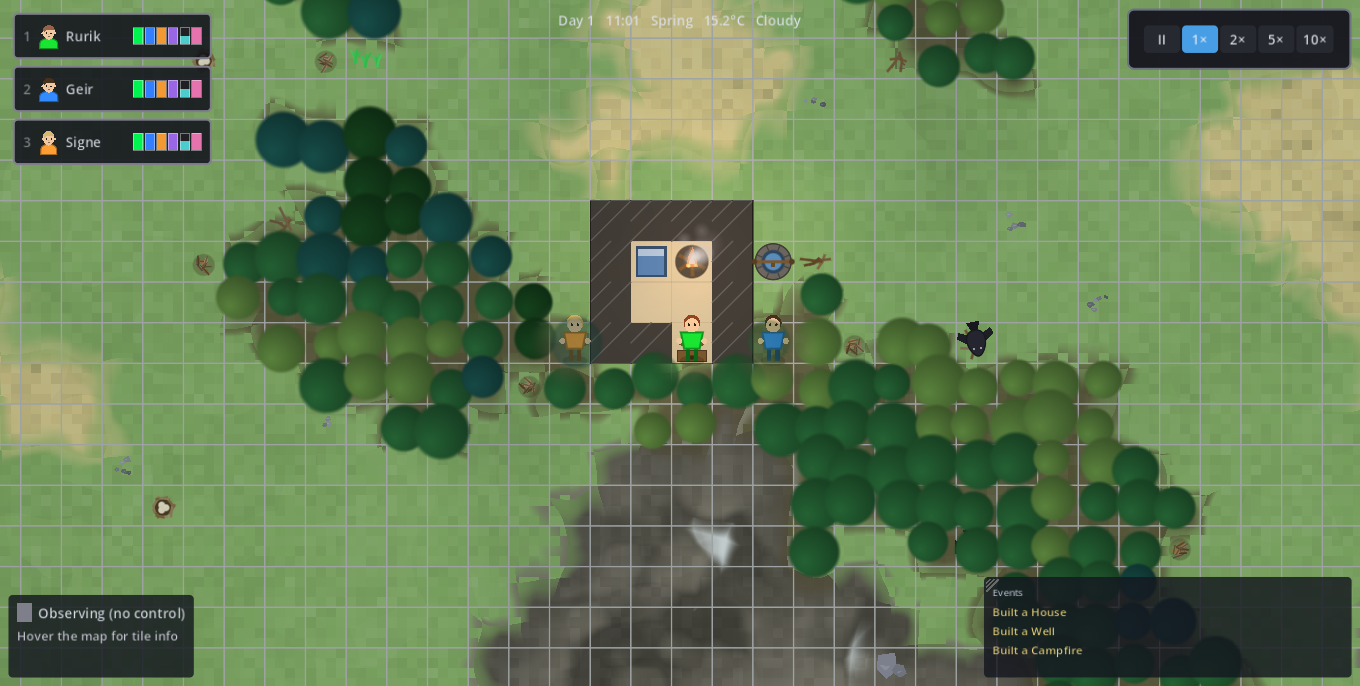
A self-designed house is not an object you can click, so the furniture panel hangs on the room: left-click any cell of an enclosed room and it opens, reading the room out (cells, shelter warmth, how homely it is) and listing the furniture that may go in it. Pick a piece and the ghost only accepts cells inside those walls — otherwise it is an ordinary construction site: builders fetch the materials and raise it. Click inside the same room again, or press Esc, to close. It resolves last of all map clicks, so anything with a panel of its own (a pile, a fire, a construction site) keeps the click.
| Piece | Cost | Labour | What it is |
|---|---|---|---|
| Straw bed | 6 leaves | none (instant) | A poor night's sleep — and the one piece that needs no room: it is in the Supply ring too, so it can go down beside the campfire on the first evening |
| Bed | 6 leaves + 1 wood | 14.4 s/cell = 28.8 s | The proper one: rests faster and heals while you sleep. It lies 1×2 — press R before placing to turn it across |
| Stone hearth | Stone + wood, needs a mason's yard | 10.8 s/cell | The indoor fire: a campfire's warmth, ~3× the burn per log and a wider reach. One hearth holds a house through a winter night, and it cooks like any fire |
The two beds are told apart by their LABOUR, not by their price (2026-07-21):
their materials are nearly identical, so what separates them is the work. A straw bed sets
build_seconds_per_cell = 0 — instant: total_build_seconds()
floors at 0.001, so the first frame of a builder's work finishes it. The materials still have to be
carried to the site; only the labour is nil. The bed costs twice what it used to (7.2 →
14.4 s per cell). The entry tooltip quotes the labour in in-game time for one builder
(BuildEntry.labour_line); helpers stack their deltas and shorten it.
A room is not yet a home. Its comfort is the average over its cells of the floor laid on them and the furniture standing in them, and that comfort lifts Mood while a companion is inside — doubled while asleep. Over-furnishing simply finishes the room; it is capped, never an exploit.
Automate — press T T
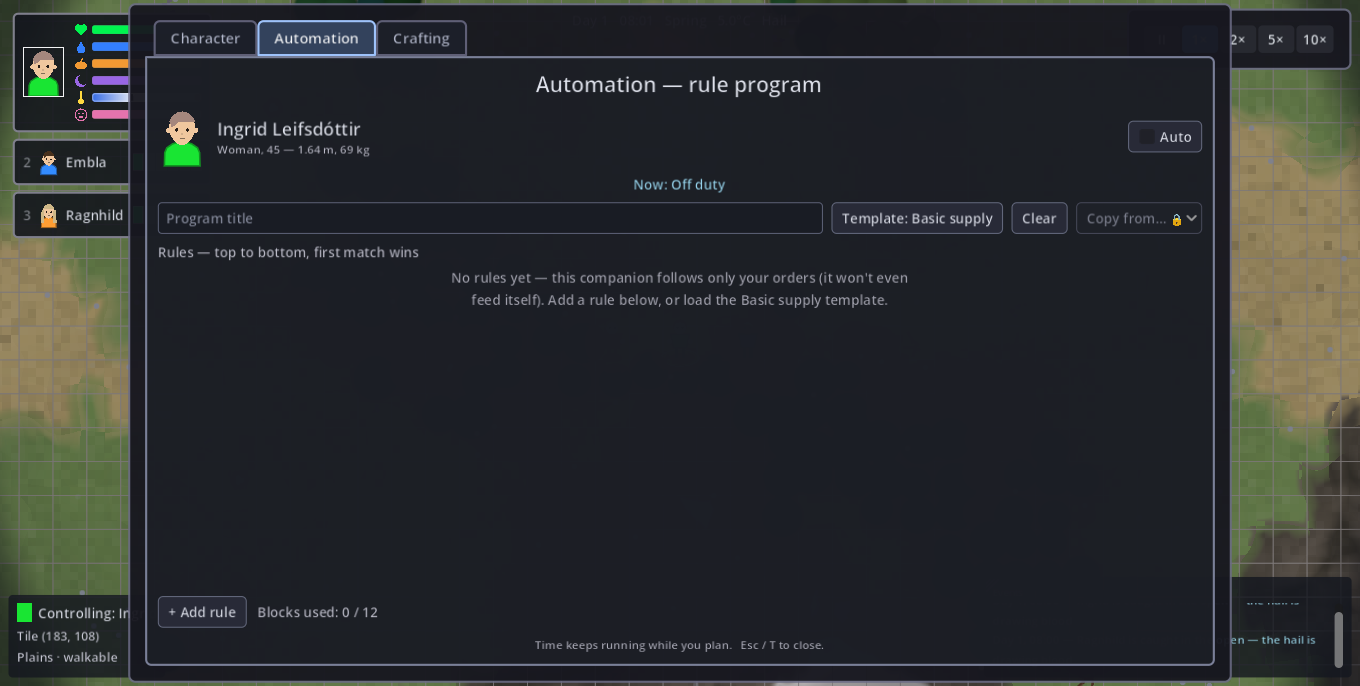
Automation is built, not switched on. Write each companion a program — an ordered list of rules reading WHEN condition(s) → DO action UNTIL release. Order is priority.
- WHEN — sensors: the body's bars (Health & Mood too), Wetness, Sickness, the clock, the season, precipitation, city stores, the own carry, the waterskin, fire fuel, a waiting site. Conditions AND together.
- DO — actions: the trades (fell, fish, farm, quarry, hunt), drink, eat, sleep, warm/cool, tend fires, build, haul the carry to stores, fetch items into the carry, and take a task off the task board.
- UNTIL — the latch: "fell wood UNTIL stores ≥ 60" keeps a rule going past its trigger so companions don't ping-pong at the threshold.
- Nothing happens that nobody asked for (11.7): no companion carries its load home on its own. A full pack stops the work that would fill it further (harvesting into a full pack destroys the node for nothing) and the rest of the program runs on. Bring it in by right-clicking a stockpile, with a WHEN Carry full → Haul rule, or via the task board — a task's goal sits in the city stores, so delivering is the last leg of it. Any haul keeps a ration of every food kind and of drinking water: the load goes, the lunch stays.
- Blocks are budgeted: a rule costs 1 block, +1 per extra WHEN, +1 for an UNTIL; the whole settlement shares one budget (base 12, +6 from a Planning table). Rules past the budget don't run — top rules are paid first.
The task board (needs a Planning table): buildings watch their own needs and post tasks — a fisher's hut calls for a fisher while stores hold under 20 fish, a burnt-down fire calls for tending, open sites post themselves. One 1-block Take a task rule claims the nearest posting, so a new recruit is just one more taker. Trades are earned: each work action stays locked until its workshop stands. Workers only seek what the party has already discovered.
Time & world
Day/night and seasons pass; the clock, temperature (°C) and weather sit top-centre. Speed controls (or -/.) run pause / 1× / 2× / 5× / 10×.
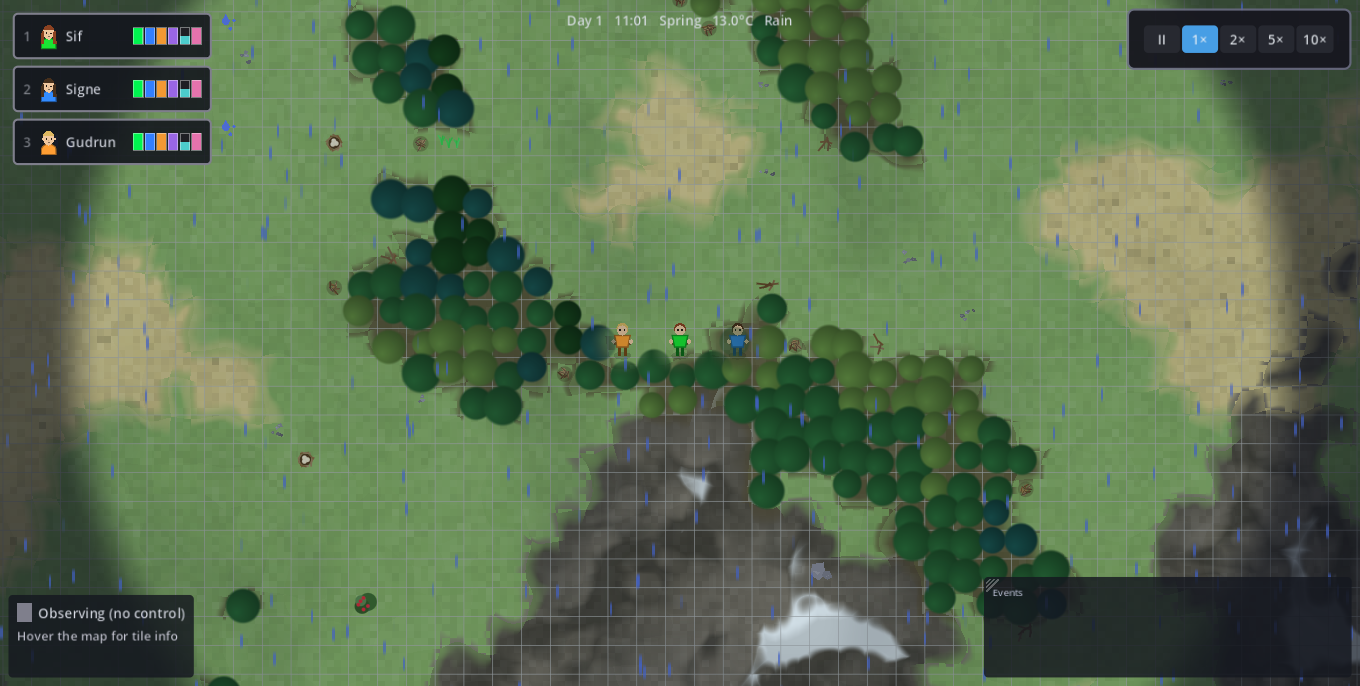
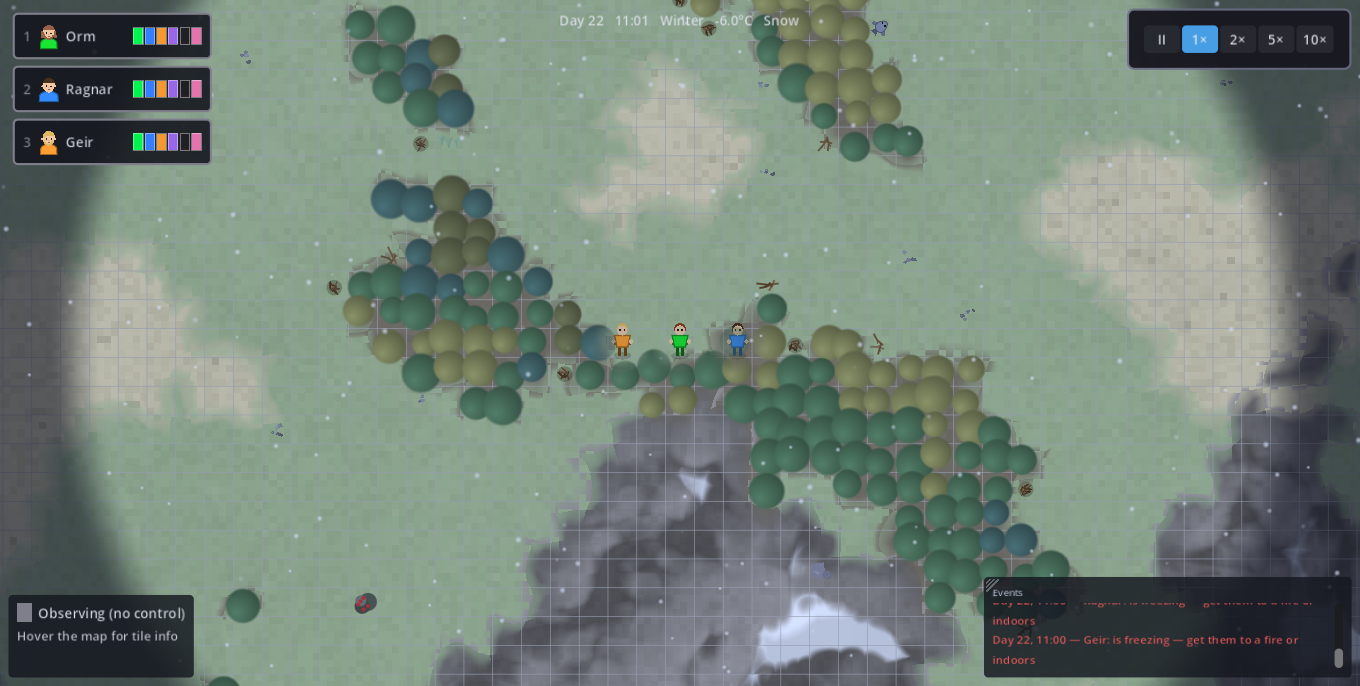
Weather follows the seasons — sunshine, cloud, rain, hail, summer drought, winter snow. Hail hurts (bleeds Health in the open; only a roof or forest canopy stops it). Rain soaks (wet = up to 30% colder). Wet clothes dry fastest at a campfire or under a roof (~4 in-game hours from soaked through) — and out in the open as fast as the sky allows: ~10 h under warm sunshine, about a third of that pace when overcast, and nothing at all in cold air or while rain, snow or hail falls. A summer soaking dries itself while the work goes on; a winter one waits for a fire. In deep winter rivers and lakes freeze (wells keep serving); a summer drought dries small ponds until the next rain.
Water has a quality as well as a salinity. A body of fresh water that never reaches the sea — a lake, a pond — is still water: drinkable, and every gulp builds the drinker's dysentery load — nothing on its own, but the pond you keep going back to breaks out as the illness. Rivers drain to the sea and count as running along their whole length, and so do wells and hot springs. A waterskin filled at a lake carries pond water with it until it is drunk dry. Choosing between a lakeside site and a river (or a well) is the point.
The cure is a fire. Right-click one and pick Boil water: the companion pours everything untreated it carries — the pack first, then its waterskin — into the hearth's pan, waits for it, and takes the clean water back (skin first, the rest into the pack). Empty-handed the same order simply collects what is already boiling. By hand it works too: right-click the tool slot in the character sheet (C) to pour the skin into your hand, then set it down on a fire (the whole skinful goes in), on a barrel, or on another companion to fill their skin.
Boiling costs time, and that is deliberate. A full waterskin takes one in-game hour on a campfire; a stone hearth is three times faster at everything it cooks. The pan holds 20 units and boils unattended while the fire burns, so you load it and walk away — but one pan cannot water a whole party, and it cannot sear fish while it boils. Boiling is the stopgap at a pond; a river or a well is the answer.
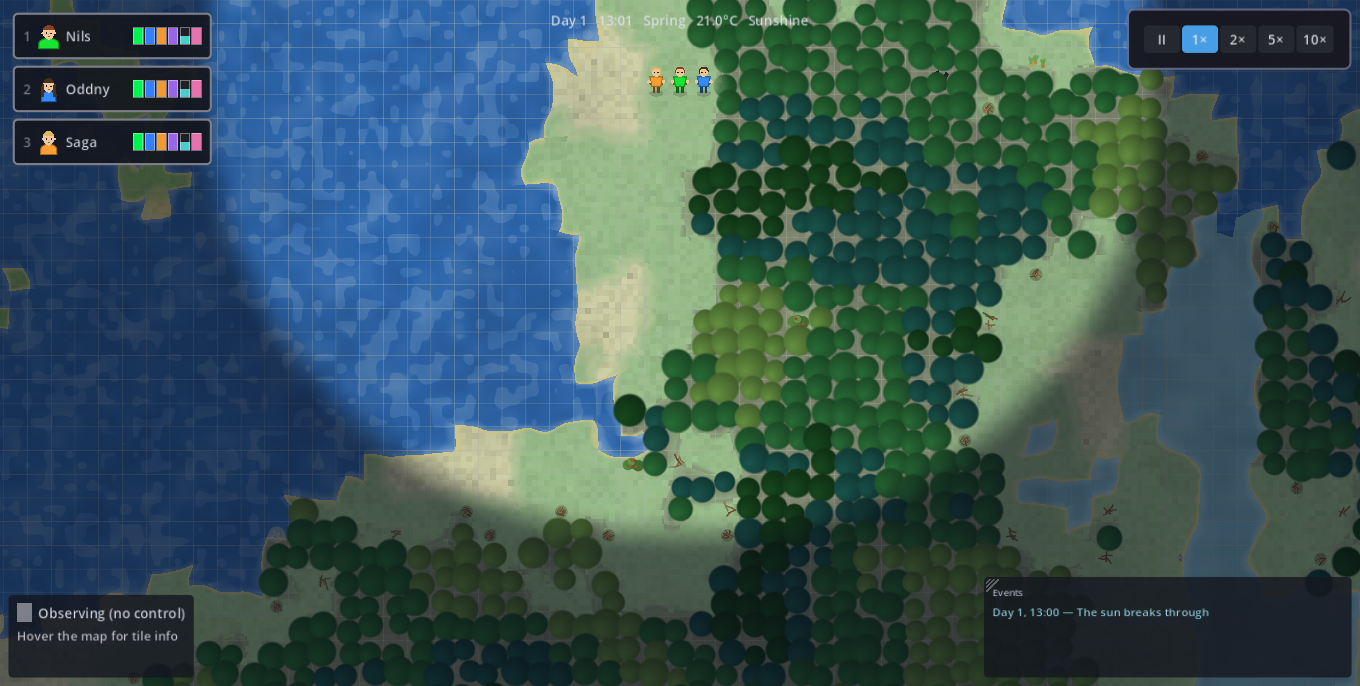
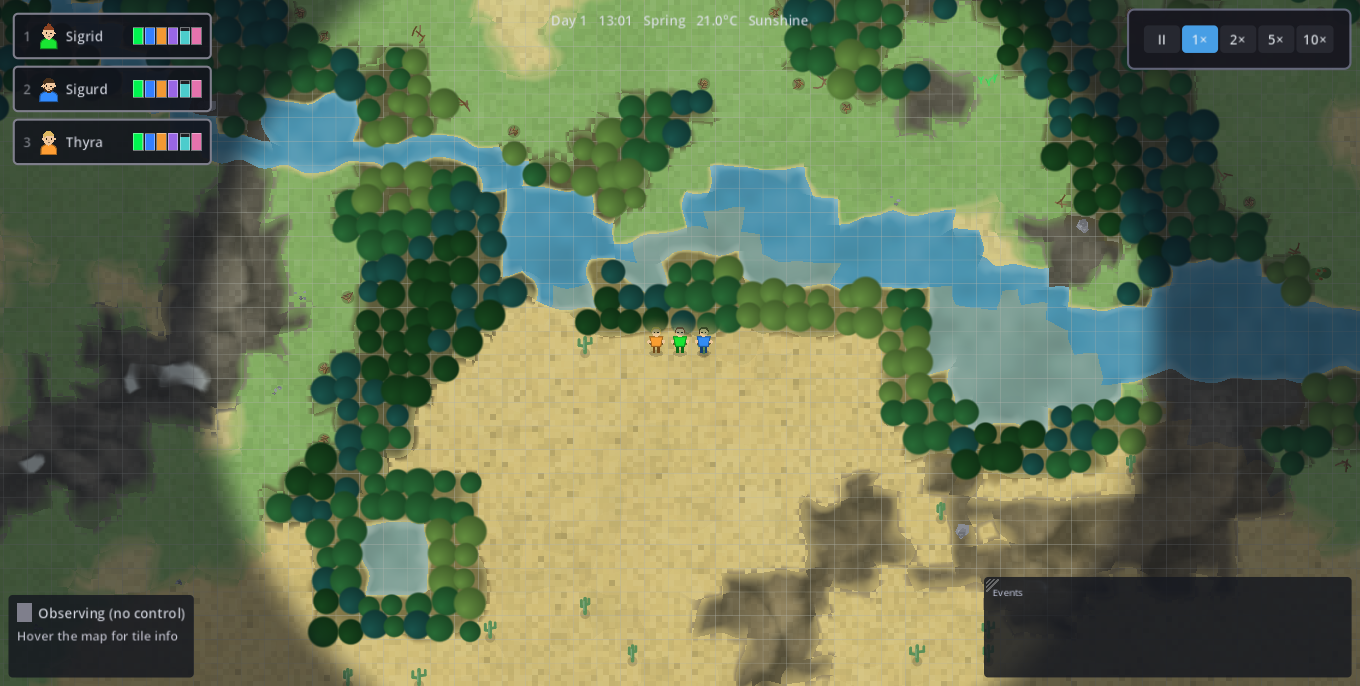
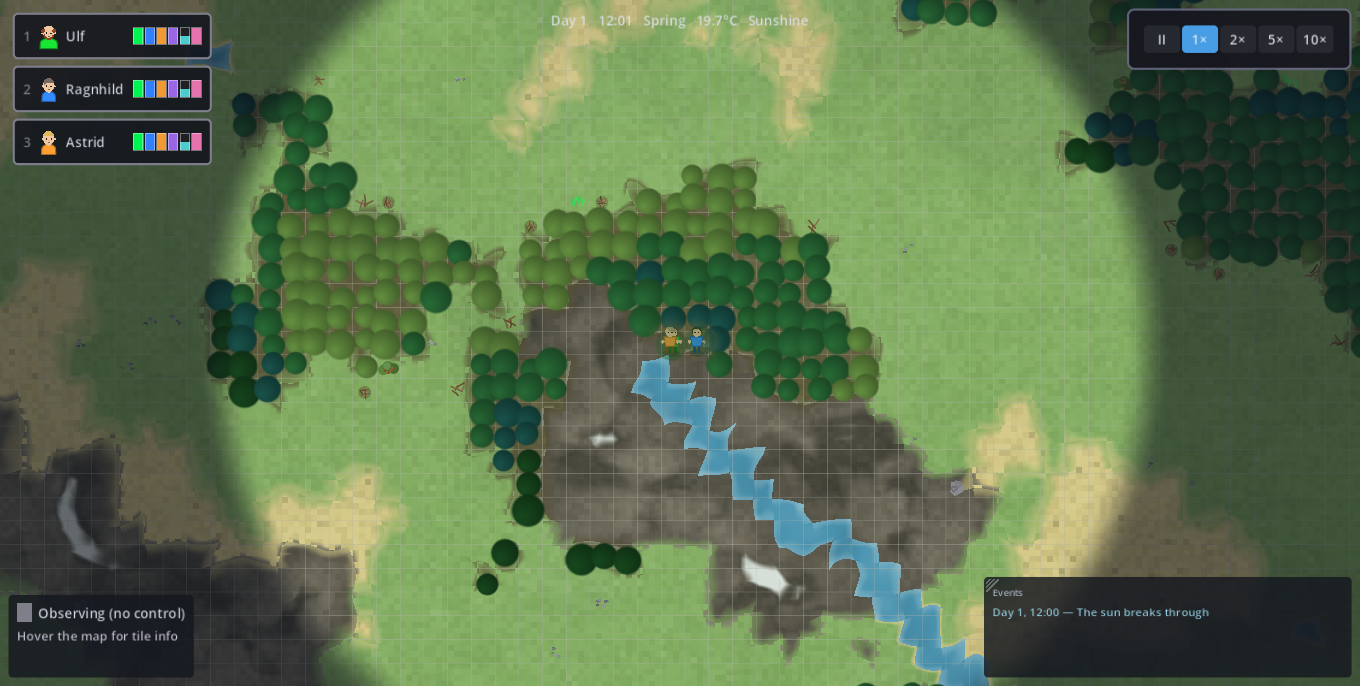
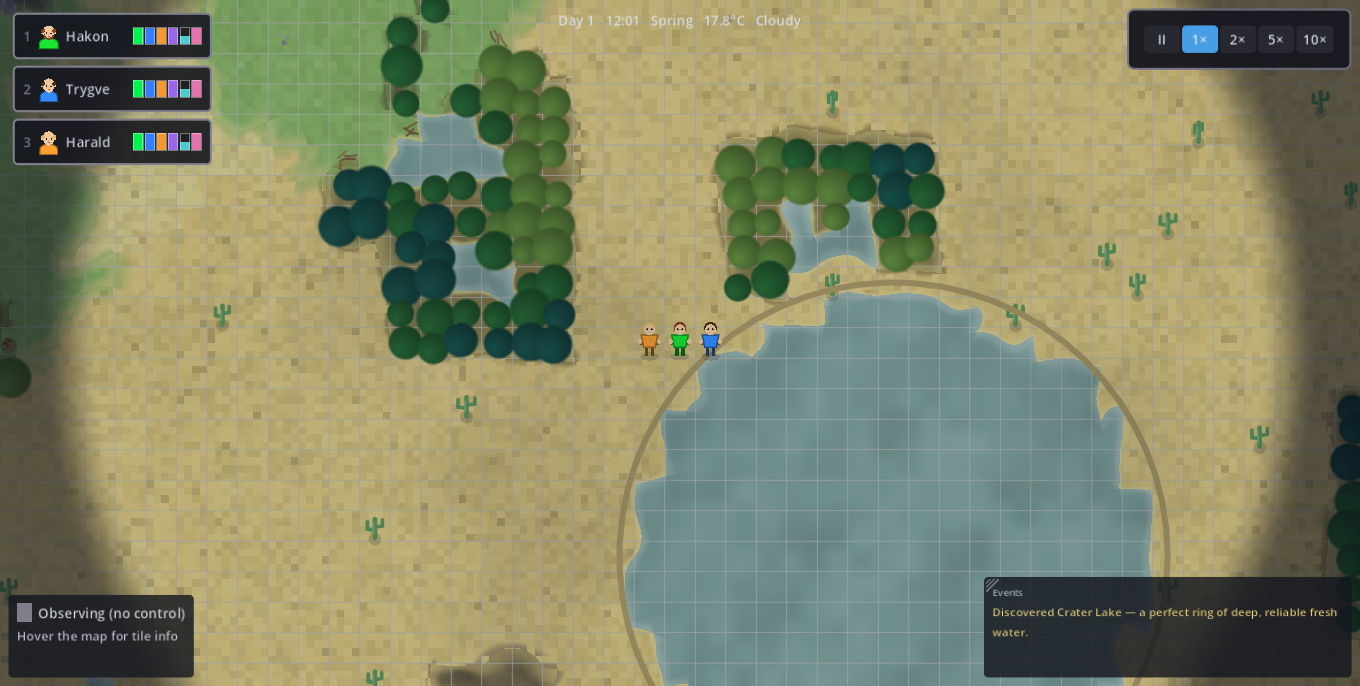
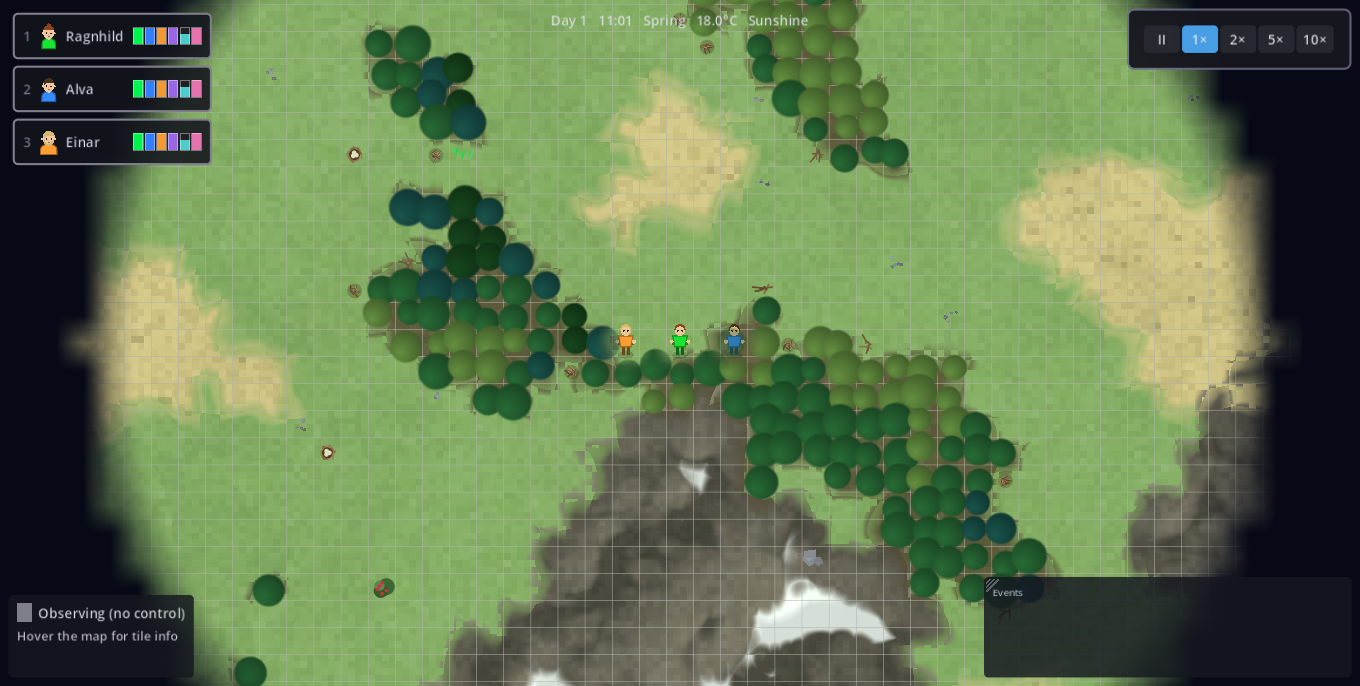
The land itself has a climate. Most of the island is temperate, but three kinds of country are not: tundra (−10°C) on the high northern fringe, desert (+8°C) in the dry south, and swamp (soaks you like rain, and a fire can't dry you while you stand in it). The seasons turn both extremes inside out — knowing which half of the year a country is survivable in is worth more than avoiding it.
Interface & keys
The companion window holds everything you do to one companion, as three tabs — each key opens its own tab (press again to close; Ctrl+Tab walks the tabs). All three are about the companion you're steering.
| Key | Action | Key | Action |
|---|---|---|---|
| C | Character tab (stats, skills, carry) | Space | Build ring (radial menu) |
| T | Automation tab (rules) | Tab | Next companion (+camera) |
| K | Crafting tab (bedroll, cordage, bow, rod) | 1–0 | Select companion (twice = camera) |
| E | Gather (hold) | H | Aim & shoot (bow, hold) |
| F | Centre camera on selection | M | Widest zoom |
| G | Toggle fog (debug) | - / . | Game speed up / down |
| J | Chronicle (saved history) | F1 | Help |
| F5 / F9 | Save / load slot | Esc | Close open window, else pause/settings |
| F12 | Dev console (debug builds) | Rebind everything in Esc → Settings | |
Architecture & conventions
Engine, layout, and the ground rules the codebase holds itself to.
- Engine: Godot 4.x, 2D top-down. GDScript only (no C#).
- Language: all identifiers, comments, node/scene names in English — no German anywhere in code or the scene tree.
- Naming:
snake_casefor vars/funcs/signals/files;PascalCasefor classes/nodes/scenes;class_namefor reusable scripts. - Data-driven: tunables live in
.tresResources (resources_data/) and@exportvars — not magic numbers. Numbers should be tunable without touching code. - Decoupling: cross-cutting state lives in autoload singletons; systems talk through signals where it decouples them.
| Path | Holds |
|---|---|
| scripts/autoload/ | Singletons (managers, world & save state) |
| scripts/player/ | Companion rig: stats, skills, controllers, jobs, automation |
| scripts/world/ | Worldgen, terrain/biome/landmark, renderers, camera, weather, fog |
| scripts/resources/ | Resource nodes, animals, harvest cycle |
| scripts/buildings/ | Buildable, build controller, sites, stockpile inventory |
| scripts/items/ | Item catalog, item graphics, ground items |
| scripts/ui/ | HUD, panels, dev console, settings, screens |
| resources_data/ | All .tres configs: buildings, animals, resources, stats, skills, palette, theme |
| tests/ | Headless suite + benches + the screenshot harness |
Autoload map
The singletons every system reaches. Persistent autoloads must reset in
WorldGenerator._ready (a reload doesn't re-instantiate them).
| Autoload | Owns | File |
|---|---|---|
GridManager | Cell↔world math, occupancy grid | autoload/grid_manager.gd |
TerrainManager | Per-cell terrain / biome / landmark layers, walkability, water bodies, climate | autoload/terrain_manager.gd |
TimeManager | time_of_day, day, season; ambient temperature; rollover signals | autoload/time_manager.gd |
TimeWarpManager | Pause / 1–10× via Engine.time_scale | autoload/time_warp_manager.gd |
WeatherManager | Season-weighted weather spells, snow cover | autoload/weather_manager.gd |
FogManager | Three-state per-cell visibility | autoload/fog_manager.gd |
PartyManager | Members, selection, embodiment | autoload/party_manager.gd |
BuildingManager | Placement, sites, rooms, action-area serving, water bodies | autoload/building_manager.gd |
CityInventory | Aggregate facade over all stockpile tiles | autoload/city_inventory.gd |
AnimalManager | Running population tallies, capacities | autoload/animal_manager.gd |
TaskBoard | Building-posted tasks (11.6) | autoload/task_board.gd |
SaveManager | Named save slots, migration seams | autoload/save_manager.gd |
EventLog / Chronicle | Live feed / saved history | autoload/event_log.gd, chronicle.gd |
SoundManager | Zoom-gated positional audio, UI clicks | autoload/sound_manager.gd |
KeybindManager / GraphicsManager / GameState / ResourceManager / GroundItemManager | Input, graphics prefs, run state, resource registry, dropped stacks | autoload/… |
World generation & terrain
WorldGenerator.generate() builds the world.
TerrainManager.is_walkable(cell) is THE passability seam (nav bake, collision,
standability, rooms all read it — a bridge's set_walkable_override opens a crossing
for all of them). TerrainManager.climate_offset_at(cell) is THE climate seam.
TerrainManager.is_drinkable_water() is THE drink seam; is_fresh_water()
is salinity only; is_still_water() is THE quality seam (7.5 — a body that reaches no
sea), and IllnessController.wear_bad_water() is the one place an untreated drink is
billed.A cell has three orthogonal per-cell layers: terrain (what it physically is — world/terrain_types.gd: PLAINS/WATER/FOREST/MOUNTAIN/SAND/SHALLOW), biome (its climate — world/biome_types.gd: temperate/ tundra/swamp/desert, grown as one region each), and landmark (world/landmark_types.gd: crater lake / hot springs / standing stones).
Key tunables — scripts/world/world_generator.gd
| Group | Exports (on the WorldGenerator node in Main.tscn) |
|---|---|
| Shape | world_seed, noise_frequency, island_falloff[_power], sea_level, mountain_level, forest_moisture, sand_share |
| Rivers | river_count (2), river_max_half_width (1.7), river_meander_strength (2.2, ceiling ~2.4), river_meander_wavelength, river_source_flank, river_bias_* |
| Forest | wood_per_forest_cell (20), birch_/spruce_/oak_share |
| Biomes | tundra_share, desert_share, swamp_share, swamp_bog_count, biome_terrain_affinity |
| Landmarks | crater_lake_count/radius, hot_springs_count/radius, standing_stones_count/radius, landmark_min_spacing |
| Spawn | spawn_water_min_walk/max_walk (60/90), spawn_open_land_share |
chunk_cells 64, ~0.1s at 512², one wall re-bakes
only its chunk ~5ms) and every spawn count is a density via
TerrainManager.area_scale() (walkable land over REFERENCE_WALKABLE_CELLS
≈203000). 512 is a design choice (3–5 cycles/run), not a performance one.Rendering: world/terrain_renderer.gd (per-cell texture),
terrain_snow.gdshader, tree_canopies.gd (crowns draw over
walkers at z 4; _apply_walkers feeds the reveal+sway shader),
room_floor_renderer.gd, fog_overlay.gd. All world
colours live in resources_data/palette.tres via GamePalette.
Nav: walkable_navigation_region.gd; collision: terrain_collision.gd.
Resources & animals
.tres
(resources/resource_type.gd); a creature is a .tres
(resources/animal_species.gd) — a new creature needs no code branch.
ResourceType.restock decides where a source comes back;
HarvestCycle.work_node is the one harvest seam; Animal._can_enter is the
movement seam (flies); ItemCatalog holds per-kind nutrition/shelf life.| Concern | File / config | Notable fields |
|---|---|---|
| Resource definitions | resources_data/resources/*.tres | spawn_terrain, spawn_biome, yield_item, harvest_time, work_scale (rock/fish 10), restock, spawn_seasons, regrow_days, spawn_abundance |
| Spawning & restock | world/resource_spawner.gd | count_per_type (120, a density), _target_count, _pick_restock_cell |
| Animal species | resources_data/animals/*.tres | flies, flee_radius_cells (0 = never flees), speed_variance, carrying_capacity, initial_population, food_yield, spawn_near_fresh_water_cells |
| Animal behaviour | resources/animal.gd, world/animal_spawner.gd | Parametric _draw; breed_check_days (no per-frame registry scan); _can_enter |
| Harvest & felling | resources/harvest_cycle.gd | chop_tree → TerrainManager.chop_wood; HARVEST_TIME_SCALE 1.8 |
AnimalManager.count_of() is a
running tally, so _spawn() calls setup() before
add_child(). And "every animal stands on walkable terrain" is false — fliers only obey
the map edge.Companions
The companion rig is scenes/player/Player.tscn / class_name Player,
instanced three times as nodes Character1/2/3 (a node name is a save key
— rename via SaveManager.RENAMED_CHARACTER_NODES). Behaviour is split across small
controllers on the rig.
| Controller / file | Owns | Key seams / tunables |
|---|---|---|
| player/player_stats.gd (+ player_stats_config.gd) | The six stats, decay, sleep_debt | stat_changed signal; config in resources_data/stats/*.tres |
| player/vitals_controller.gd | Eating/drinking application, healing gate | heals_at_rest(), begin_meal/drink_if_below (the ONLY consumption entries) |
| player/temperature_controller.gd | Drift toward felt warmth | _target_warmth() (climate offset, then campfire maxf); in_danger_band() |
| player/wetness_controller.gd / comfort_controller.gd | Wet debuff, room-comfort Mood | _standing_in_swamp; room_quality_at |
| player/illness_controller.gd | Ailment onset/cure | runs whatever player/ailments.gd declares |
| player/ailments.gd | What each sickness IS | cause, course, cure — a new one is one entry |
| player/character_skills.gd (+ skill_set_config.gd) | Learning by doing | practice() = XP entry, multiplier() = effect; resources_data/skills_config.tres |
| player/job_runner.gd | Executes jobs/needs; the tuning heart | see below |
| player/command_controller.gd / worker_commands.gd / worker_needs.gd | Right-click resolution, order execution, need handlers | hold/drag thresholds; _fetch_from_stores |
| player/character_profile.gd / nordic_name_generator.gd | Identity | display_name() = the name seam; disposition (hidden), recruited, joined_day |
| player/renegade_controller.gd | False companions (5.4b) | work_factor() (via the ONE work seam), desert_day (drawn once, saved), _tell() |
| world/wanderer_controller.gd | A rig that is NOT in the party (5.4) | its PRESENCE is the flag (Player.is_wanderer()); Phase, wanderer_at() |
Recruiting — scripts/world/wanderer_spawner.gd
A wanderer is a companion rig (Player.tscn) that has not
joined — not a second kind of person. That is the whole design: its identity, carry, drawing and
save entry are the ones every companion already has, so recruiting is
PartyManager.recruit() → rename onto a free Character<N> (a node name
is a save key) + Player.join_party(). A stranger is frozen while it waits
(Player._halt_survival) and reveals no fog. Leaving runs the other way:
Player.leave_party() attaches a fresh controller in LEAVING and the rig walks
off the map and frees itself — expulsion and desertion share that one door.
Spawner knobs: first_possible_day (6), min_days_between (6),
arrival_chance (0.22/day), linger_days (3), renegade_chance (0.3),
approach_cells (45). One stranger on the road at a time; a full party is sent nobody.
Console wanderer [spawn [renegade]|here|panel|recruit|send|desert].
SaveManager._collect_characters walks the TREE, not a name list —
the party grows now, so CHARACTER_NODES would be a lie the moment somebody joined.
A restore builds rigs the fresh world doesn't have (_rebuild_character) and
frees Players the save doesn't know. The WandererController must be attached
before the rig enters the tree, or it registers a hotkey slot it isn't entitled to.The big tuning surface — scripts/player/job_runner.gd
Movement/work: move_speed, work_seconds, mine_seconds,
fish_seconds. Needs/thresholds: need_trigger_ratio/recover_ratio,
emergency_ratio, warm_seek_below/cool_seek_above,
despondent_below. Automation: base_rule_slots (12),
dev_self_care (re-enables the dormant self-care tiers — tests / a future easier
difficulty). Hunting: hunt_range_cells, hunt_base/min/max_hit,
hunt_giveup_seconds. Fatigue penalties live on player/player.gd
(fatigue_walk_penalty, fatigue_work_penalty, mood_work_penalty).
dev_self_care. Don't silently re-add safety nets.Automation internals
AutomationProgram (an ordered
AutomationRule list); AutomationInterpreter evaluates it top-down (first
feasible triggered rule wins; UNTIL latches). Actions are existing behaviours — rules only choose
which runs.| File | Role |
|---|---|
| player/automation_program.gd | The rule list + block budget accounting |
| player/automation_rule.gd / automation_condition.gd | One WHEN→DO UNTIL rule; a sensor condition |
| player/automation_interpreter.gd | Top-down evaluation, latch, live diagnosis (ACTIVE/blocked/waiting) |
| ui/automation_panel.gd | The rule editor (Automation tab) |
| autoload/task_board.gd + buildings/building_task_rule.gd | Buildings post need-driven tasks; the "Take a task" block claims the nearest |
Work actions are gated by standing workshops (Buildings). Old saves
migrate a painted schedule into time-window rules on load. Console: rules, prog,
tasks, auto.
Buildings & construction
Buildable .tres
(buildings/buildable.gd) — a new building is data, not code.
BuildingManager._serves is the action-area seam (every find_*_near passes
through it). Buildable.paint (CHAIN/AREA/single) drives placement.
makes_walkable + TerrainManager.set_walkable_override is the bridge seam.
_stand_by = which cell to use a building from. Buildable.cost_alternatives
+ pick_cost = the "9 twigs or 3 wood" seam: a site commits to ONE variant, so
everything downstream (delivery, the fetch trip, the panel, the save) still sees a plain cost
dictionary.| Concern | File | Notes |
|---|---|---|
| Building definitions | resources_data/buildings/*.tres | cost, cost_alternatives, size, category/secondary_category, action_radius, build_seconds_per_cell, room_warmth, comfort, speed_factor, heat_output/radius, burn_seconds, yields_item, task_rules |
| Placement / ghost / paint | buildings/build_controller.gd | request_build_path; CHAIN walls, AREA floors; ghost console |
| Placement rules, rooms, serving | autoload/building_manager.gd | cell_placeable, _room_id_at (≤400-cell flood), warmth_at/sheltered_at, adjoining_water_body, floors in _floor_cells |
| Construction sites | buildings/construction_site.gd | Fetch/deliver/build; saved (incl. its committed cost variant); reconsider_cost re-picks while nothing is delivered; cancel_site drops materials |
| Building node & panels | buildings/building_node.gd, ui/building_panel.gd, construction_site_panel.gd | stack_at = "what lies on this cell" |
SaveManager._restore_rank): a floor can't be laid on an occupied cell, so restoring a
bed before its planks loses the floor silently.Items, inventory & storage
ItemCatalog (items/item_catalog.gd)
is the ONE data seam for weight, nutrition and shelf life — there is no generic "food" item, every
source yields its kind. ItemGraphics.draw() is THE inventory look.
Inventory is weight-based (capacity_kg, space_for) with FIFO
age batches. StockpileInventory.tile_layout() = one type/tile, 20 units;
CityInventory aggregates.| File | Role |
|---|---|
| items/item_catalog.gd | Per-item weight / nutrition / shelf_days / rest_factor |
| items/item_graphics.gd / ui/item_icon.gd | Procedural item drawing (world + inventory) |
| player/inventory.gd | The carry: kg budget, take_amount/take_all_of, age batches |
| buildings/stockpile_inventory.gd | Physical tile store, storage rules |
| items/ground_item.gd + autoload/ground_item_manager.gd | Dropped stacks (age as they lie) |
| player/world_hand.gd + ui/character_sheet_panel.gd | ONE hand (owned by the sheet, character_sheet group); resolve order site>stockpile>hearth>companion>ground |
| ui/transfer_panel.gd | Carry↔pile and carry↔carry exchange window |
Time, weather & temperature
TimeManager only tracks & broadcasts
(time_changed/day_changed/season_changed) — it knows nothing
about gameplay. WeatherManager.get_effective_temperature() is the one weather-temp
seam. Ambient feeds TemperatureController._target_warmth().| File | Exports / seams |
|---|---|
| autoload/time_manager.gd | day_length_seconds (18 min), days_per_season (7), start_time_of_day, per-season *_temp, day_night_swing; get_ambient_temperature(), jump_to_day() |
| autoload/weather_manager.gd | min_/max_spell_hours, temperature_jitter, snow_accumulate_/melt_per_hour |
| world/day_night_cycle.gd | CanvasModulate tint interpolation |
| world/weather_particles.gd / weather_hazard.gd / cloud_shadows.gd | Rain/snow/hail particles, hail Health damage, cloud shadows |
Temperature damage: cold below 4°C / heat above 35°C (temperature_controller.gd).
Pacing: the 18-minute day and ×1.8 task lengths; HARVEST_TIME_SCALE is the harvest seam.
UI & panels
StatVisuals = glyph+tier+colour;
StatusEffects.list(character) = "what is on this companion right now". The
companion window is one framed TabContainer with three tabs
(C/T/K) — a tab's visible ≠ the window standing, so read
is_visible_in_tree().| File | Role |
|---|---|
| ui/hud.gd | Root HUD; binds the companion window on control switch |
| ui/companion_window.gd + companion_header.gd | The 3-tab frame; subject()/bind_character(); host_of() |
| ui/character_sheet_panel.gd / automation_panel.gd / crafting_panel.gd | The three tabs (Character / Automation / Crafting) |
| ui/character_status_panel.gd / stat_bar.gd / stat_visuals.gd / status_effects.gd / stat_icon.gd | Party cards, bars, badges |
| ui/alert_screen.gd | Mortal-danger heartbeat (fires at EMERGENCY health tier; health_alert.gdshader) |
| ui/build_radial_menu.gd | The build ring: one _draw, hit-testing by angle+radius (no node per sector); geometry COMPUTED from the sector count |
| ui/build_categories.gd | The tree as DATA. Categories declared here; entries GROUPED from the live catalog by Buildable.category — never a list of ids. PLANNED = the greyed placeholders (empty since 16.3, kept as the mechanism). FURNITURE is a real category id deliberately NOT in CATEGORIES, so it gets no sector — the room panel asks for it directly. entries_for matches category or secondary_category, so a piece that belongs in two lists says so itself (the straw bed: furniture and Supply) |
| ui/room_panel.gd | Furniture hangs on the ROOM, not a building (16.3). Binds to a cell, never a room id (ids regenerate on every placement). Drives the ordinary BuildController.select_buildable(buildable, fence) — never a second placement pipeline. Console room panel |
| ui/building_icons.gd | BuildingIcons.draw() = the building icon seam (the twin of ItemGraphics.draw); monochrome, unit-square, one drawing per Buildable.id — unknown id → silent fallback swatch. Console icons audits which entries still wear it |
| ui/build_icon.gd | BuildIcon = the Control that PICKS the seam: a kit (yields_item) draws as its item via ItemGraphics, everything else as its building. Used by the shared entry button and the construction-site panel |
| ui/build_entry.gd | BuildEntry.cost_labels_for() / tooltip_for() feed the ring's info panel AND the crafting tab — one source for what a thing costs |
| ui/loading_screen.gd | Pushed phases; everything switched via RenderingServer (force_draw()) |
| ui/event_log_panel.gd / chronicle_panel.gd / task_board_panel.gd | Feed / history / task board |
| ui/wanderer_panel.gd | The recruiting decision (5.4): identity + attributes, take in / send on. Must never read the hidden disposition |
| ui/pause_menu.gd | The Esc ladder (closes ui_windows group before pausing) |
| ui/settings_panel.gd + gameplay/graphics/audio/keybindings_settings.gd | Settings; rebinding writes per-domain .cfg |
Save / load
SaveManager._collect_state / _apply_state. Saves are named
slots on disk (user://saves/<name>.save). brutal_testing_saves
is true while the prototype is tested (Brutal saves/loads freely) — flip it to restore the
permadeath pillar.Node names are save keys (see Companions). Since recruiting (5.4)
_collect_characters walks the tree, not a fixed name list, and
_rebuild_character builds the rigs a fresh world doesn't have. Restore obeys a rank
order (ground → structures → fixtures). Difficulty (Hard = free save/load, Brutal =
suspend-only + slot wipe) is picked on the title screen. Console: saves, save,
load, delsave, difficulty.
Console commands
F12 opens the dev console (debug builds only). Handlers live in scripts/ui/dev_console.gd. Every new mechanic should ship a console command.
| Area | Commands |
|---|---|
| Companions / stats | select, who, stat, fill, skill, fatigue, weight, wet, sick, effects, alert, face, figures, wanderer |
| Windows / items | sheet, rules, crafting, transfer, hearth, hand, skin, give, drop, cook |
| World / terrain | world, biome, landmark, rivers, salt, freeze, water, tree, chop, canopy, relief, navmesh, sites, room [panel], tp, reveal, fog |
| Time / weather | time, day, season, speed, weather, clouds, tint |
| Resources / animals | res, animal, hunt, regrow, restock, spoil |
| Building / automation | build, radial, ghost, cancelsite, area, pilerule, freebuild, unlockjobs, auto, prog, tasks |
| Save / meta | save, load, saves, delsave, difficulty, god, chronicle, music, shot, scenario, float, version, help, clear |
Testing & tools
| Tool | Command | Purpose |
|---|---|---|
| Headless suite | godot --headless --script res://tests/run_tests.gd | Smoke & regression tests |
| Screenshot harness | godot --path . --script res://tests/screenshot.gd -- out=… seed=… grid=… cmd="…" | Boots the real game with rendering, stages state via console, saves a PNG (needs a display — DISPLAY=:1, not --headless). These wiki screenshots were made with it. |
| Soak test | tests/soak_test.gd | N-day base-balance net (not in the suite) |
| Benches / probes | tests/animal_bench.gd, grid_benchmark.gd, river_probe.gd, water_probe.gd, sim_night.gd | Targeted performance / behaviour probes |
Godot binary for this environment: ~/Downloads/Godot_v4.7-stable_linux.x86_64. After
adding a class_name, rebuild the class cache before headless tests. Claude cannot see the
running viewport — visual work is verified through the screenshot harness or by the developer.
screenshot.gd with the same out=, seed= and
cmd= line and drop the PNG back in place.Versioning
One number, one source, and the two things it is deliberately not.
The game's version lives in exactly one place:
application/config/version in project.godot — the engine's own
field, so an exported build carries it in the PCK for free. Everything in the game reads it through
GameVersion (scripts/main/game_version.gd), a static class like
BuildCategories: GameVersion.string() gives "0.2.0",
GameVersion.label() gives "v0.2.0" — the one spelling every screen uses, so
no label re-types the "v".
Scheme: plain semver. While the prototype runs at 0.x, MINOR goes up
per completed feature batch and PATCH for fixes; 1.0.0 is reserved for the release that
closes the run arc (ROADMAP Milestone 10, the migration cycle). Milestone-derived numbering was
rejected — milestones complete out of order, so the version would have run backwards.
SaveManager.SAVE_VERSION is the save file FORMAT — the only number that may ever
refuse to load a file. GameVersion is the build that wrote it, stamped into each
save's header as game_version and shown in the save browser's tooltip. A save from an
older build always loads; the stamp is provenance, never a gate.Where it shows: the title screen's bottom-right corner, the pause menu, every save's header, the
console command version (which also prints the engine build and the save format), the
Windows executable (mirrored into export_presets.cfg), and the line at the
top of this page.
Cutting a release (full steps in CHANGELOG.md): bump
project.godot, mirror the number into
export_presets.cfg and this page, write the changelog section, run the
headless suite, commit, then git tag -a v<version>. The suite fails if the
three copies drift apart — that check is what keeps the mirrors honest.
Keeping this in sync important
When a player-facing mechanic changes (a control, a building, a gather target, a survival rule):
- Edit
HelpPanel.HELP_TEXTin scripts/ui/help_panel.gd — the single on-screen source of player help (its nav is derived from the section headers, so keep the[font_size=17][color=#9ec1ff][b]…[/b]header format). - Update the matching Player Guide section here.
- If the change touches code structure (a new file, seam, tunable or console command), update the matching Developer Reference section and, if relevant, re-shoot the screenshot.
- Mirror every edit into wiki/index.de.html, the German twin, in the same commit.
#anchor across, so a
section must never exist in only one of them. Their <style> and
<script> blocks are byte-identical on purpose: edit the look in
one and copy the block into the other — wiki/deploy.sh compares the two
and warns when they drift. The deploy uploads both files (and the hook fires for either).The developer reference is derived from the seam catalogue in the project memory index (memory/MEMORY.md), where each system names its one seam — the fastest place to confirm where a mechanic actually lives.
Companions — prototype developer wiki. Player Guide mirrors the in-game F1 help; Developer Reference maps mechanics to files, seams, tunables and console commands. Screenshots made with tests/screenshot.gd (seed 12345).